


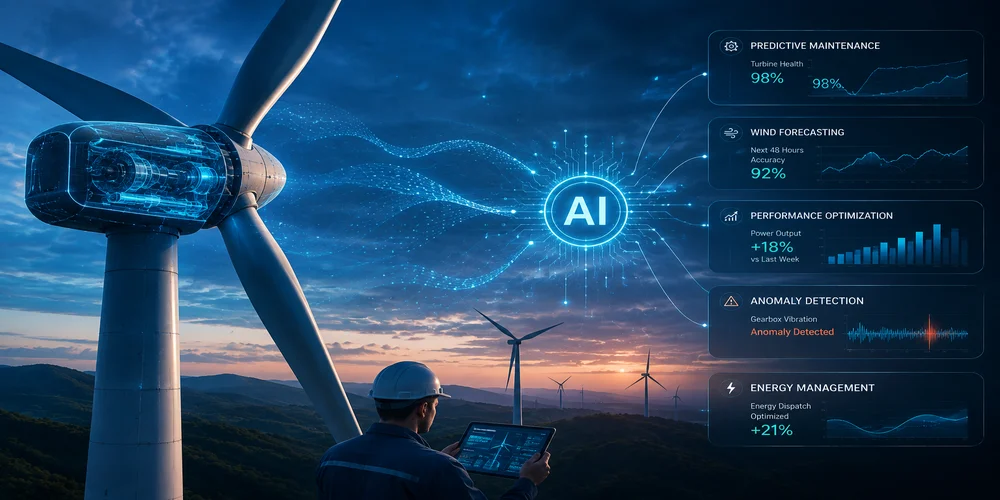
AI in Wind Energy: Driving Smarter, Safer and More Efficient Wind Farms
Artificial intelligence though devised recently is no longer a futuristic technology. Its role has become undisputable in driving many of the technologies we rely on every day. Right from the simplest tasks like answering queries, suggesting a learning schedule, help automate job applications, developers have extended its application in critical fields like engineering. Industries are keenly adopting this technology to become smarter and more efficient.
The renewable energy sector has also taken cognizance to this trend. Especially, the wind energy sector. We note that wind turbines are growing taller, more powerful and increasingly complex as time evolves. AI is revolutionizing several aspects of the way wind turbines now operate.
As countries across the world steer towards cleaner energy, AI has become the digital brain behind modern wind farms. By refining performance, predicting maintenance needs, maximizing green energy generation, AI is surely shaping the future of wind energy. Wind turbines can now think smarter, perform better and produce more power than before.
Let us now dive deep into the different aspects of WTG where artificial intelligence finds its interesting application.
Optimizing turbine design
AI platforms streamline the full engineering lifecycle by using deep learning and genetic algorithms. This helps tune aerodynamics, structural weight and wake interactions. In place of designing blades for generic conditions, AI allows for designing by considering site specific geometries. This results in maximized Annual Energy Production (AEP) and reduced Levelized Cost of Energy (LCOE). The following are areas that AI finds its crucial application.
Aerodynamic blade optimization
AI uses Deep Reinforcement Learning (DRL) and Convolutional Neural Networks (CNN) to work on airfoil geometry.
- Deep Learning models replace slow Computational Fluid Dynamics (CFD) to predict lift and drag Coefficients in milliseconds as compared to hours
- It generates unique blade chord distributions, twist angles, winglet designs to optimize power extraction at low cut-in speeds
- It designs microstructures (e.g., serrated trailing edges) to significantly reduce aerodynamic noise.
Structural integrity and Material efficiency
AI uses Generative Adversarial Networks (GANs) to balance light weight with structural survival.
- It helps determine the lowest possible amount of fiberglass or carbon fiber required inside the blade spar gap (The space between the spar caps).
- This is beneficial to reduce blade weight, improve structural efficiency & aerodynamic performance and lower manufacturing costs
- The detailed advantages include extended lifespan of turbine components, shorter curing times, lower transportation costs, enhanced energy capture and reduced fatigue loading
AI uses Recurrent Neural Networks (RNNs) to analyse multi-axial stress-strain history to predict structural delamination and cracking over a 25-year lifespan
- It integrates Finite Element Analysis (FEA) with fluid structure simulations to predict how a blade will twist under varying wind loads. This helps engineers understand mechanical characteristics and bending behavior accurately and quickly
- It helps in finding the exact ply orientations for Bend-Twist Coupling (BTC) by evaluating thousands of fiber stacking sequences. This is useful for obtaining the desired twist without impacting structural integrity. Thus, the blades are able to twist and shed aerodynamic load during sudden, dangerous wind gusts
- It aids in the design of hybrid systems that combine passive BTC with active pitch control. This makes the turbine self-regulate and dynamically adapt to variable wind conditions reducing extreme loads and significantly lowering fatigue damage
Wind farm layout and wake mitigation
Before construction begins, algorithms test thousands of geographical configurations against local wind atlases. This is to find the best of cost-effective and high-yield arrangements.
Wake interactions are aerodynamic effects that take place when the disturbed airflow generated by an upstream turbine flows into a downstream turbine. This is relevant for wind farms where turbines operate in a cluster.
In addition to optimizing a single turbine, AI also helps in optimizing wind farm layout at a macro level to mitigate wake turbulence.
- By using Particle Swarm Optimization (PSO) it positions turbines in a non-grid layout tailored to historic wind roses (long term patterns of wind speed, direction & frequency at a specific location) to minimize wake losses
- Algorithms adjust blade pitch and yaw (horizontal rotation of the entire nacelle) in real time in line with varying wind speeds
- It trains AI controllers to slightly change the alignment of upstream turbines to deflect the turbulent wake away from downstream turbines to boost wind farm efficiency
Predicting weather patterns
AI plays an important role in power forecasting by predicting future wind conditions accurately and estimating how much electricity a wind farm would generate likely. Traditional forecasting methods rely on fixed mathematical models. However, AI continuously learns from huge amounts of historic data as well as real time data, making its predictions more accurate over time.
- AI collects data from multiple sources like weather satellites, radar systems, Meteorological stations in addition to Supervisory Control and Data Acquisition (SCADA) sensors of the wind turbine
- It combines the data from Numerical Weather Prediction (NWP) models
- This gives information on parameters like wind speed, direction, humidity, atmospheric pressure, temperature and air density
Recognizing complex weather patterns
Conventional models may often miss out on predicting subtle weather patterns unlike AI algorithms. This is since the latter analyzes years of historic weather data alongside live conditions.
- AI can understand the combined effects of variables that constantly influence one another. For e.g. It can make connections of how wind direction and pressure in a specific region create a certain wind pattern
- It can also predict how seasonal changes affect wind speeds differently for different turbine heights. For instance, in summer the wind at 100 m and 180 m might differ only slightly whereas in winter, the wind at 180 m may be substantially faster than at 100 m, resulting in significantly greater power generation
Predicting future wind conditions
- By using machine learning models, AI can forecast wind speeds at different heights, changes in wind direction, gust intensity and turbulence levels
- This forecast can range from few minutes ahead to several days in advance
Forecasting power output
After determining future wind conditions, AI uses the following in a combination to predict electricity generation.
- Weather data and satellite imagery
- Historical generation patterns involving individual turbine’s power curve and operational data
Automatic adjustment of forecasts
AI systems also learn to improve accuracy by constantly comparing the predicted power output Vs the actual power generated. Any difference is used to retrain the model thereby improving the accuracy of future forecasts. If wind speeds are expected to fluctuate or decrease, the power forecast is adjusted automatically.
This is helpful for
- Traders in energy markets to make informed decisions
- Grid operators to maintain a stable electricity supply by balancing supply and demand
- Utilities to reduce dependence on backup fossil fuel power plants for greater sustainability
Enabling predictive maintenance
AI helps turbines identify potential failures before they actually occur. Instead of following a fixed maintenance schedule or rather waiting for a component to fail, AI relentlessly monitors turbine’s health and predicts when maintenance may actually be needed. This offers the advantages of reduced downtime, lower maintenance costs and improved energy production.
Predictive maintenance process
- Modern wind turbines are equipped with hundreds of sensors that regularly monitor critical components.
- AI gathers data that includes vibration levels, bearing temperatures, gearbox oil quality, generator performance, rotor speed, blade pitch angle, wind speed and direction, electric current and voltage
- AI analyzes historical operating data to make note of what a healthy turbine performance looks like, for varied weather conditions and power output. This creates a digital baseline for each turbine
- When it detects deviations from the normal pattern, it flags them as potential faults, even when the turbine is operating normally. For instance, a blade may experience unusual loading due to a developing crack. Such subtle changes often are too small for traditional monitoring systems to identify
- Using machine learning models trained on historical failure data it estimates which component is likely to fail, the probability of failure and the remaining useful life of the component
- Instead of stopping the turbine immediately, it recommends optimal maintenance window by factoring in weather & wind conditions, technician availability, spare parts inventory and electricity prices.
- This supports wind farm operators in scheduling maintenance during periods of lower expected production to avoid costly emergency repairs
- Thus, the lifespan of equipment and operating efficiency are improved
Facilitating Automated inspections
Eliminate the need for violent emergency stops
- AI prevents high stress braking for inspections. This eliminates structural stress
- It continuously models wind patterns and turbine physics to anticipate problems hours in advance. This is done to safely feather the blades (turn them parallel to the wind) to slow the turbine down gently and smoothly
Remove technicians from high-risk environments
- Traditional troubleshooting involves technicians to climb hundreds of feet into the nacelle while a turbine is locked down. Being in the vicinity of a high-voltage equipment, with heavy moving parts, hundreds of feet above the ground poses risks such as electrocution, mechanical crushing or falls.
- AI greatly reduces the need for risky, hands-on physical inspections. AI driven computer vision can be used to process imagery from autonomous drones and robots quickly. External structural checkups can now be done in under 30 minutes. Sensor data makes it possible to identify the exact internal bearing or gear tooth that is degrading. Hence technicians can climb the tower only when it is absolutely necessary knowing exactly what tool to bring
Preventing cascading power grid failures
- Shutting down multiple turbines manually by an operator in the event of an unpredicted weather event or a sudden mechanical alert can result in a large block of power dropping off the grid. This can destabilize regional electrical networks resulting in local blackouts or voltage drops.
- AI in fact coordinates the whole wind farm as a singular network. If a wind turbine goes offline for maintenance, it automatically scales up production in neighbouring turbines or draws from integrated battery storage systems to smoothly replace the lost power eliminating the need for the grid to feel a hiccup
Environmental Protection & Wildlife Mitigation
- AI helps in real-time tracking of incoming birds and bats in the immediate operating perimeter of the turbine, using computer vision and radar.
- AI driven smart curtailment systems issue command instantly to slow down or temporarily pause blade rotations thereby reducing ecological impact
- It is possible to precisely pause only the specific turbine directly in the bird’s path for a few minutes, then spin it right back after the hazard passes
- Thus, huge financial loss and constant power disruptions in the case of blanket shutdowns can be averted
NeXHS’s R&D in advanced damage detection
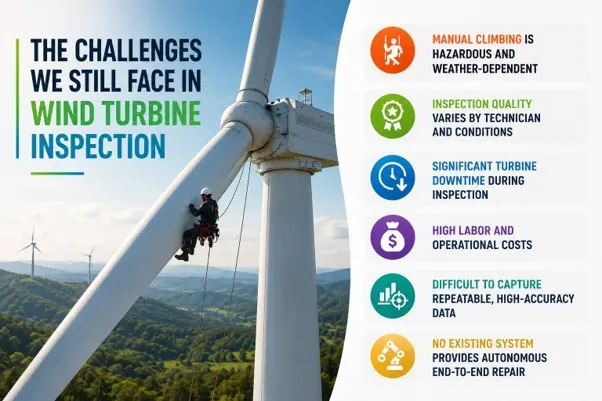
Current challenges in wind turbine inspection
There are several challenges in wind turbine inspection. Maximum safety, high accuracy, speed and repeatability need to be factored in while the inspection is carried out. The solution must also be cost effective.
The future of wind turbine inspection
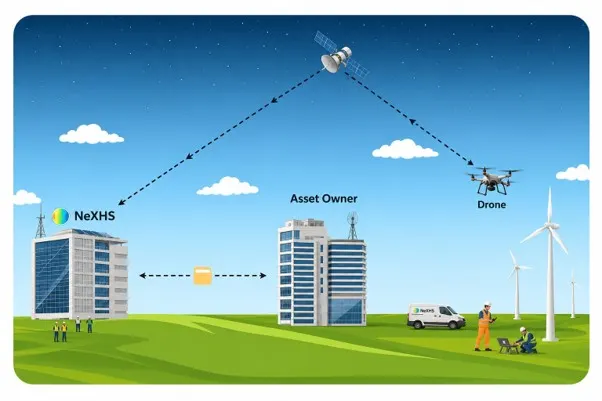
Keeping this in mind, at NeXHS we have proposed the Next Generation Wind Turbine Inspection Platform. It is an automated inspection-to-repair system that uses AI, drone, and a Non-Destructive Testing (NDT) robot.
The workflow is as mentioned below
- We use a drone to capture high-resolution imagery of the turbine.
- We use AI-assisted analysis to identify and assess potential defects from the inspection data.
- We deploy an NDT robot to the identified location for detailed condition assessment.
- We deploy a repair robot using the drone to reach the identified defect location.
- The repair robot performs the required targeted repair activity.
- We conduct post-repair inspection and generate digital reports documenting the inspection and repair outcomes.
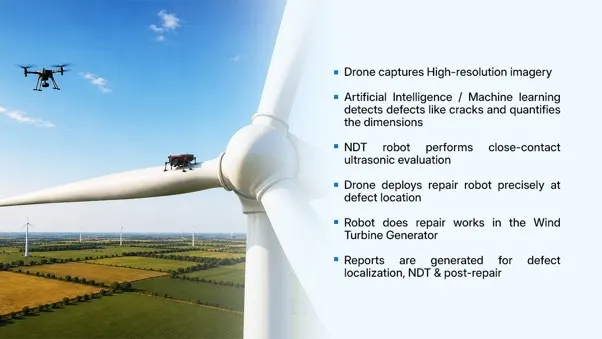
The drone performs non-contact inspection first, AI determines defect relevance, NDT validates severity, and repair is executed only when required
AI-Powered Inspection Software
- We are developing AI-based solutions to support wind turbine inspection and condition assessment
- The technology assists in analyzing inspection data and identifying potential areas of concern
- Digital tools enable efficient visualization, assessment and documentation of inspection findings
- Our approach aims to enable smarter, safer and more efficient wind turbine inspection and maintenance
Introducing our in-house drone
We are currently developing and testing NeX-Hexa 1.0, our in-house drone platform designed for wind turbine inspection applications. We are developing the platform to support high-resolution imaging and flexible payload integration for inspection operations.
Key capabilities include:
- Industrial-grade multi-rotor platform
- Modular payload integration
- High-resolution inspection imaging
- Real-time telemetry and video transmission
- Safety-focused system architecture
- Designed for extended inspection operations
Project Development Status
- We are currently conducting controlled testing and engineering validation of NeX-Hexa 1.0.
- Our development focuses on flight performance, inspection capabilities and overall system reliability.
- We will conduct further testing under representative outdoor operating conditions.
- We are progressively developing the platform toward field deployment for wind turbine inspection applications.
Applications of our drone system
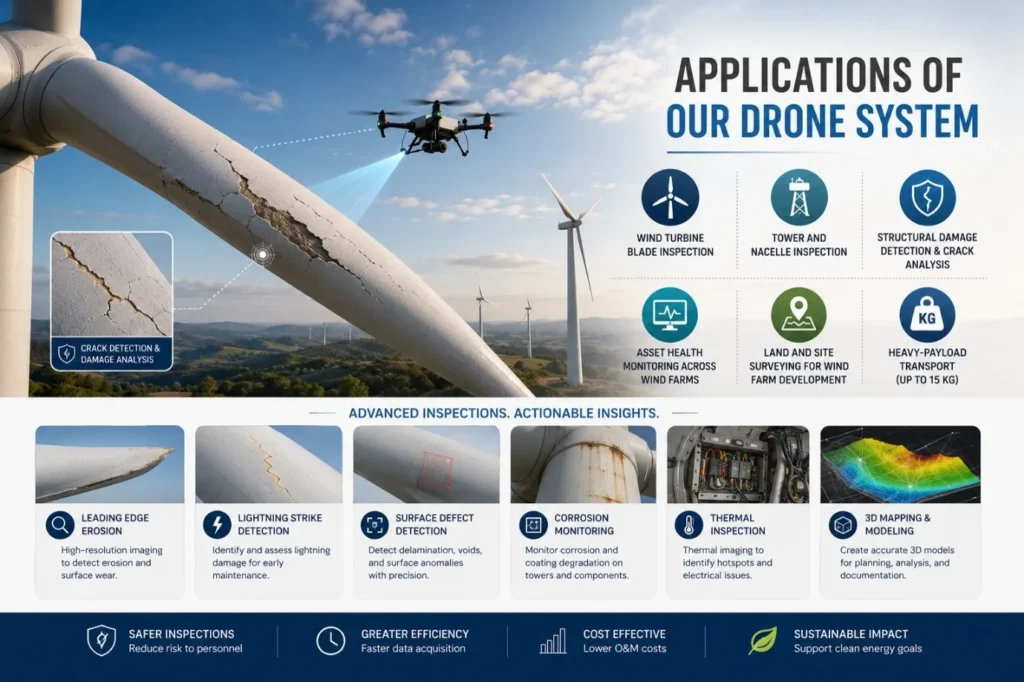
Our drone is designed to support efficient visual inspection of wind turbine blades and structures, helping identify various surface conditions and potential areas of damage. By enabling remote inspection and data-driven assessment, we aim to improve safety, inspection efficiency and maintenance reliability across onshore and offshore wind turbines.
NDT Inspection Robot
We are actively developing an NDT inspection robot to complement our drone-based visual inspection and enable detailed assessment of difficult-to-access turbine structures.
- Designed for close-contact inspection
- Supports advanced NDT-based condition assessment
- Designed for hard-to-reach inspection areas
- Integrates inspection findings into our digital inspection workflow
- Aims to reduce human exposure during inspection activities
Autonomous repair robot
As part of our long-term R&D roadmap, we are exploring an autonomous robotic system for wind turbine repair applications. The concept is designed at enabling targeted repair activities at difficult-to-access locations while reducing the need for personnel to perform certain work-at-height activities.
- Designed for targeted robotic repair
- Precision material application
- Integration with our inspection-to-repair workflow
- Designed to support efficient repair operations
- Aims to reduce personnel exposure to work-at-height activities
Conclusion
To conclude, we can surely say artificial intelligence will bring remarkable changes in the way turbine O&M is looked at. Its benefits are noteworthy and pave the way for future. Turbines will now be more reliable throughout their lifecycle. Innovations such as NeXHS’s advanced damage detection and maintenance solutions demonstrate how AI is shaping the future of safer, more sustainable wind power.