


Craneless Wind Turbine Technology: Building Taller, Safer and Smarter Towers
Introduction
The world of engineering is remarkable. Every breakthrough, from the tallest skyscrapers to renewable energy structures typically start with a bold idea. At first, many of these ideas did seem impossible. But engineers have been solving challenges that shape the way we build a more sustainable future. Ideas that once seemed impossible have been transformed into practical innovations.
We are about to explore one such innovation in this blog. At present, the focus is on wind turbine tower designs that are reaching unprecedented heights. Hybrid towers that combine the advantages of structural stability and flexible heights have become the current trend. Wind turbines with hub heights exceeding 160 metres are coming to exist. As towers keep getting taller to capture steadier high-altitude winds, the challenge is shifting elsewhere. It is no longer about designing these tall structures; it is rather finding cranes capable of installing and maintaining them.
Wind turbine transportation and installation
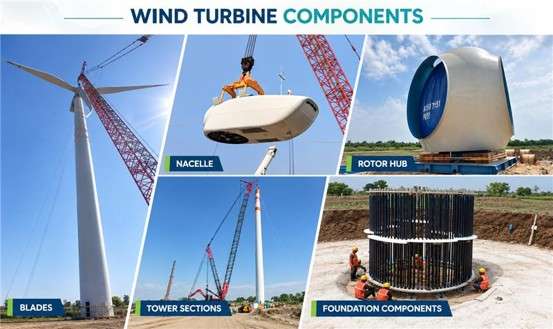
Building a wind turbine and assembling its individual components is far more complex. Tower sections, nacelles and blades are manufactured separately, transported to the site and then lifted hundreds of metres into the air. Each of these major components requires one or more heavy-lift cranes for assembly.
The role of cranes
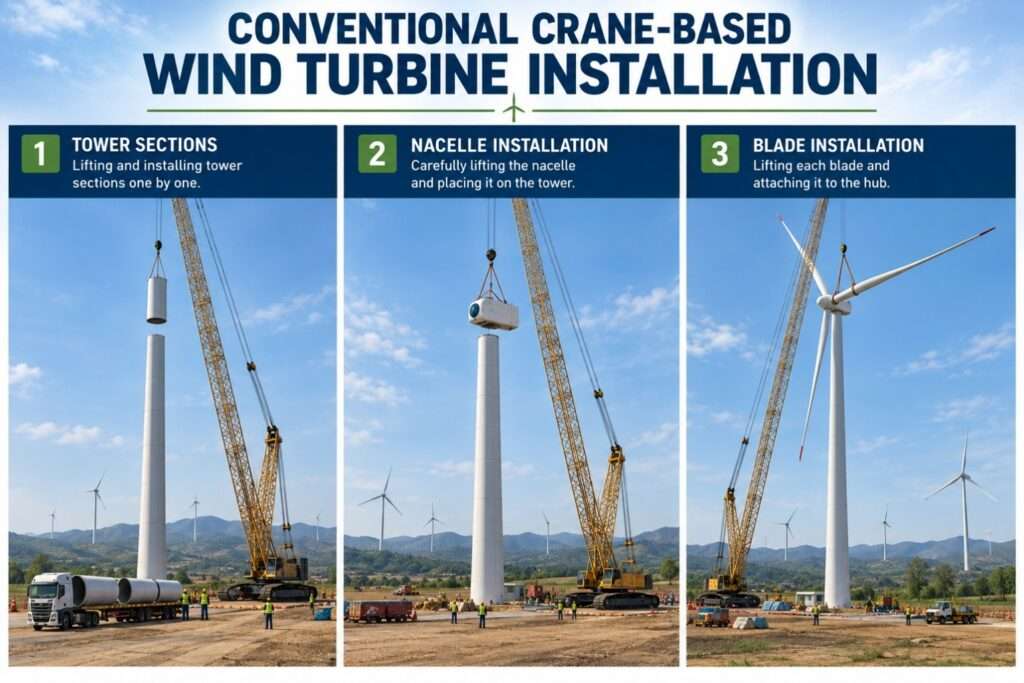
Cranes have been serving as the backbone of wind turbine installation, enabling each massive component to be safely lifted and assembled into a fully operational turbine.
The most used crane for onshore wind turbine installation is lattice boom crawler crane. It is deemed as industry standard for lifting and erecting heavy components like
- Tower sections: weighing 200 to 500 tonnes each
- Nacelles: weighing70–150 tonnes or more, depending on the turbine size
- Rotor hub: Weighing 10-20 tonnes on an average
- Blades: weighing 10-25 tonnes each; measuring 50-85 meters in length
These cranes also lift auxiliary equipment like transformers, cooling systems, internal platforms and electrical equipment. Throughout the turbine’s operating life, cranes are required to replace large components such as gearboxes, generators, main bearings, nacelles, blades and maintenance tools, for major maintenance work.
For taller turbines, these maintenance lifts can be as complex as the original installation. It is to be noted that conventional cranes perform turbine installation through a series of sequential lifts, with each component installed one at a time, requiring great precision.
The crane components have their own set of maintenance requirements, neglecting which can lead to serious accidents and catastrophic equipment failure
Why cranes become a challenge
As wind turbines continue to grow taller and more powerful, the cranes required become:
⚠️Larger and more expensive to mobilise
🚚 More difficult to transport, especially to remote or mountainous sites
🚚 Large ground preparation requirements
⏳Slower to assemble and dismantle
🌬️More sensitive to weather, particularly high winds
Let us explore the above pointers in detail
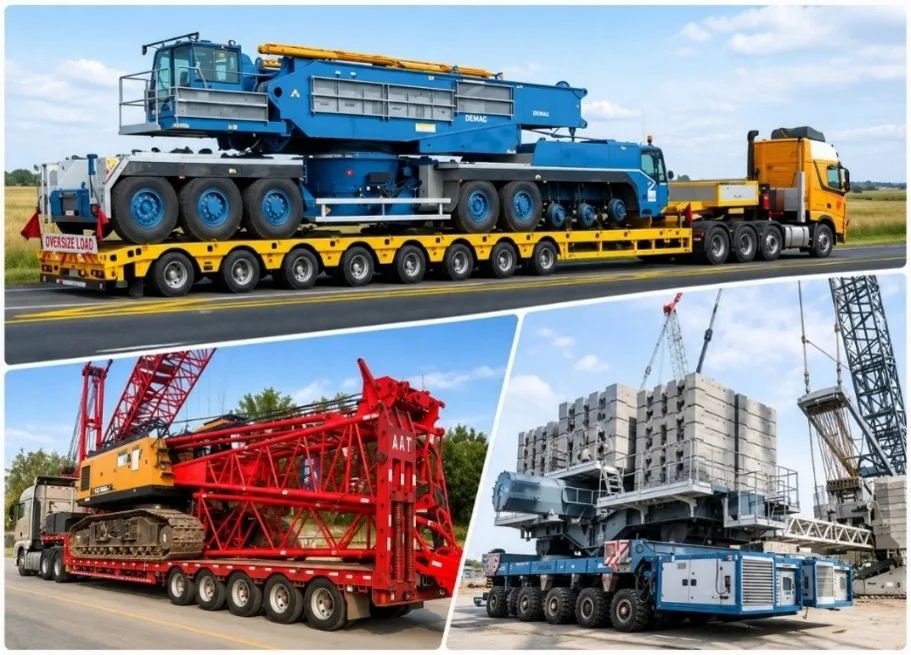
1. Larger cranes are not transported as a single machine. They are dismantled into numerous components including the boom, counterweights, crawler tracks, and support equipment.
Constraints
- Many crane parts exceed standard road size and weight limits, requiring specialized multi-axle trailers, multiple heavy-haul vehicles (on an average over 30), escort vehicles, and transport permits
- Transporting crane components involves route surveys, careful scheduling and traffic coordination that contribute to complex logistics due to huge planning effort
- This results in longer transport times
- It significantly increases transportation costs
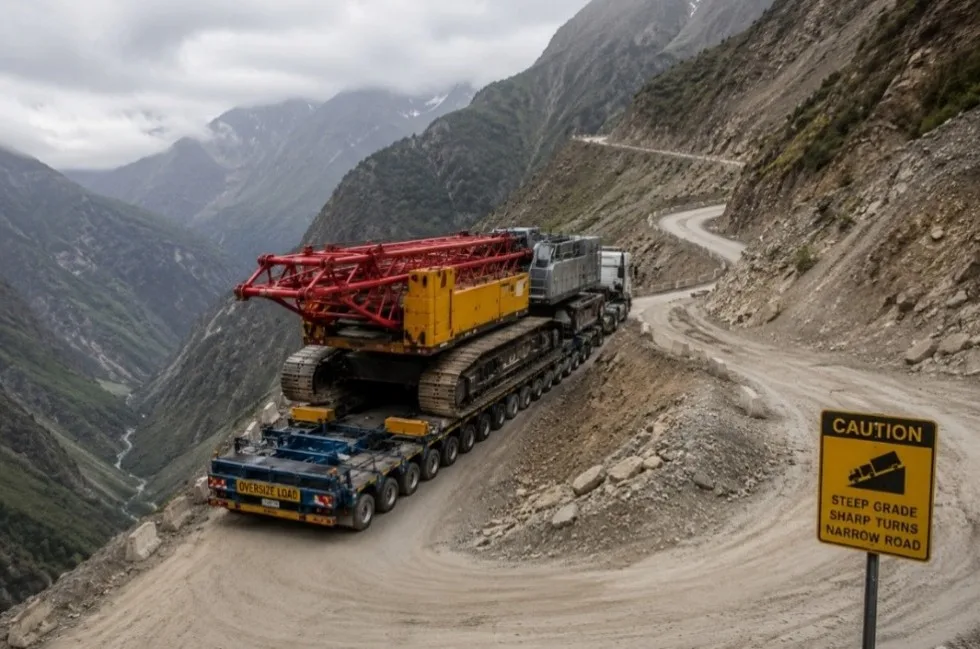
2. Remote areas generally experience higher and steadier wind speeds, allowing turbines to produce more electricity throughout the year. This advantage however comes with a challenge. Transporting the crane to remote or mountainous sites can be a complex, resource-intensive operation.
Constraints
- Depending on crane size, mobilization can require anywhere from 30 to over 100 truckloads (separate truck trips)
- Existing infrastructure may not support the axle loads of heavy transport vehicles; for instance, the minimum turning radii required is around 30 m
- This sometimes requires temporary road reinforcement, careful limitation of gradients or alternative routes
- Narrow or unpaved access roads, weak bridges, steep gradients and sharp bends commonly found in mountainous or rural areas, can restrict or even prevent crane transport
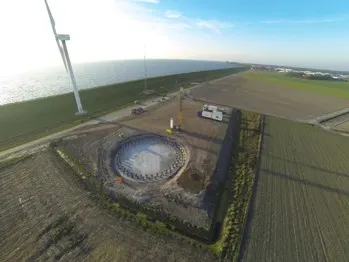
3. Conventional crane-based installation relies on extensive ground preparation, including reinforced crane pads. The pads are needed for the crane to be stable while supporting extremely heavy loads
Constraints
- Large land disturbance and substantial earthworks around each turbine location
- High material consumption, including significant volumes of crushed stone and fill
- Additional transportation costs for importing aggregate to remote sites
- Extended construction schedules, as pads must be completed and verified before crane assembly
- Environmental impacts, including vegetation removal
- Increased runoff risk if drainage is not carefully managed
- Site restoration requirements after installation, since many crane pads are temporary and must be removed or rehabilitated
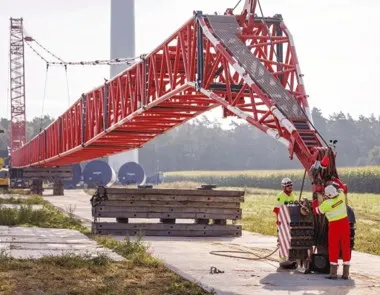
4. Crane mobilization doesn’t end with transportation; assembly and dismantling are equally time-consuming stages of the installation process.
Constraints
- Assembling and dismantling the crane itself, extends the overall project timeline
- It can take 3-7 days for assembly & 2-5 days for disassembly depending on crane size
- Requires additional equipment (sometimes 2 auxiliary cranes)
- Requires 8-15 personnel excluding transport drivers
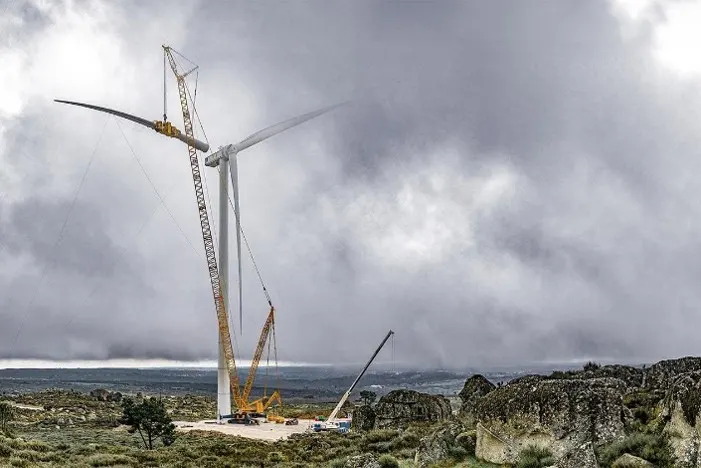
5. Crane-based wind turbine installation is dependent on extended periods of stable weather.
Constraints
- High winds, lightning, rain, fog, and ice can delay lifting operations
- Delays may last hours or even days
- Idle equipment and crews increase project costs
- This reduces installation flexibility as scheduling becomes unpredictable
Despite cranes being established and capable solutions for wind turbine installation, their logistical, economic and environmental challenges are becoming more pronounced as turbines continue to grow taller and heavier. Their global availability is also becoming scarce. This has led the wind energy sector to explore newer installation concepts that reduce dependence on very large crawler cranes.
Craneless technology as a solution
Craneless wind turbine installation eliminates the need for conventional heavy-lift crawler cranes by using self-climbing lifting systems. These are integrated into the turbine or attached temporarily to the tower.
The lifting system climbs the tower as construction progresses and hoists each component into place. This eliminates the need to bring a 600-1600 tonne crane to the site.
NeXHS Space Frame Tower with Self-Climbing Technology
Reducing crane dependency. Simplifying logistics. Rethinking wind turbine installation.
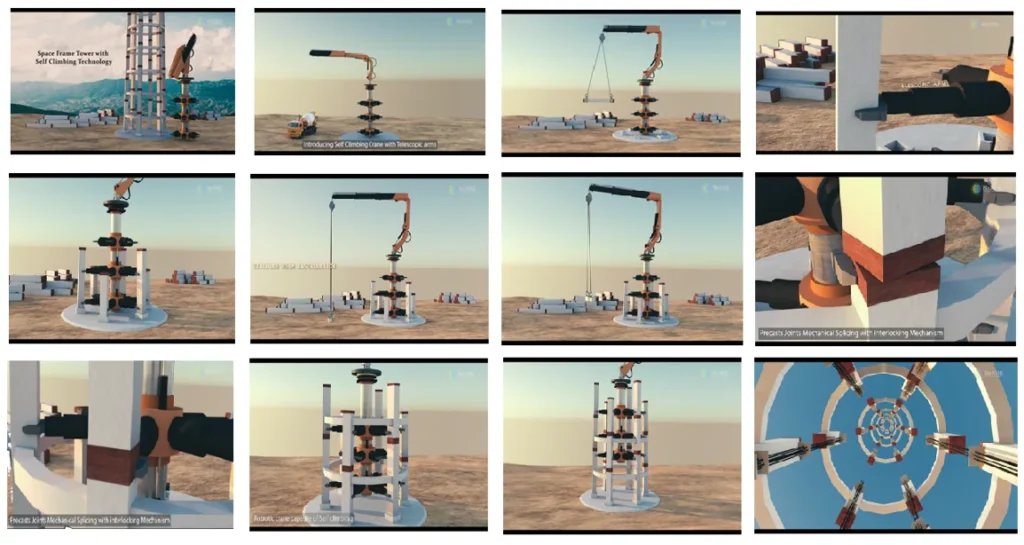
How a Space Frame with Self-Climbing Crane Works?
A smarter approach to wind turbine installation—without relying on large conventional cranes
Conventional wind turbine installation at challenging sites can require large-capacity cranes, extensive logistics, and significant mobilization time.
NeXHS offers a space frame tower integrated with self-climbing technology, enabling tower erection and turbine installation with a more compact, modular and site-adaptable approach.
01 | Establish the precast yard
A precast yard is established at the project site to manufacture the required pylon sections and circular beams.
This enables key tower components to be prepared close to the installation location, reducing transportation and logistical requirements.
02 | Manufacture & assemble the tower components
The tower is built using modular tubular or angular steel members designed for lightweight performance and structural redundancy.
Individual components are manufactured separately and transported to the installation area, where they are assembled using a specialized mechanical splicing and interlocking system.
03 | Self-climbing crane takes over
Instead of depending on a large conventional crane throughout the erection process, a self-climbing robotic crane with telescopic arms progressively climbs with the structure.
The crane lifts and positions the tower components as the space frame grows, reducing the need for large crane mobilization and associated logistics.
04 | Progressive tower erection
The space frame is erected modularly and progressively, with the self-climbing crane moving upward as installation advances.
This approach is particularly suited to sites where crane access, transportation, and mobilization of large lifting equipment can be challenging.
The connection securely locks the sections together, enabling progressive tower erection.
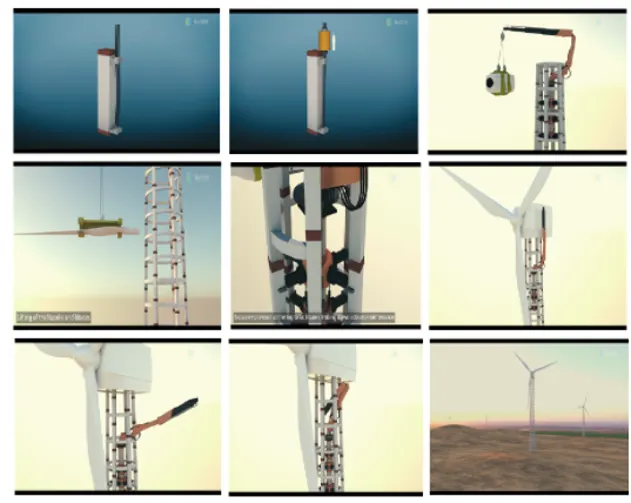
05 | External post-tensioning
An external post-tensioning system is incorporated into the tower structure.
The externally accessible arrangement supports inspection and maintenance, while contributing to the overall structural performance of the tower.
06 | Nacelle & blades installation
Once the tower reaches the required height, the nacelle and blades are lifted into position using the self-climbing lifting system.
This completes the major turbine installation without requiring the continuous presence of a conventional heavy-lift crane.
07 | Built-in access for maintenance
The space frame tower incorporates an exclusive provision at the top for climbing-based access, supporting maintenance activities throughout the turbine’s operating life.
This creates an installation concept that considers not only erection, but also long-term accessibility and maintainability.
Why space frame + self-climbing technology?
Reduced dependence on large cranes
– Minimizes the need for heavy conventional crane mobilization at suitable sites
Lower logistics requirements
– Modular components and on-site fabrication can simplify transportation and site logistics
Faster modular erection
– Progressive assembly allows the tower to be erected section by section
Site adaptability
– The self-climbing concept is particularly valuable for challenging or constrained installation environments
Maintenance-ready design
– Dedicated climbing access and externally accessible systems support future maintenance
Conclusion
Apart from the above-mentioned benefits, what drives adoption of this technology is reduced overall project costs and carbon footprint. As mentioned earlier in our blog, using very large cranes contributes to project costs through crane rental, transportation, assembly and dismantling. Project cost is further amplified by those related to operators & specialist crews and site preparation. It is estimated that craneless technology has the potential to reduce overall project economics by 8-14%