


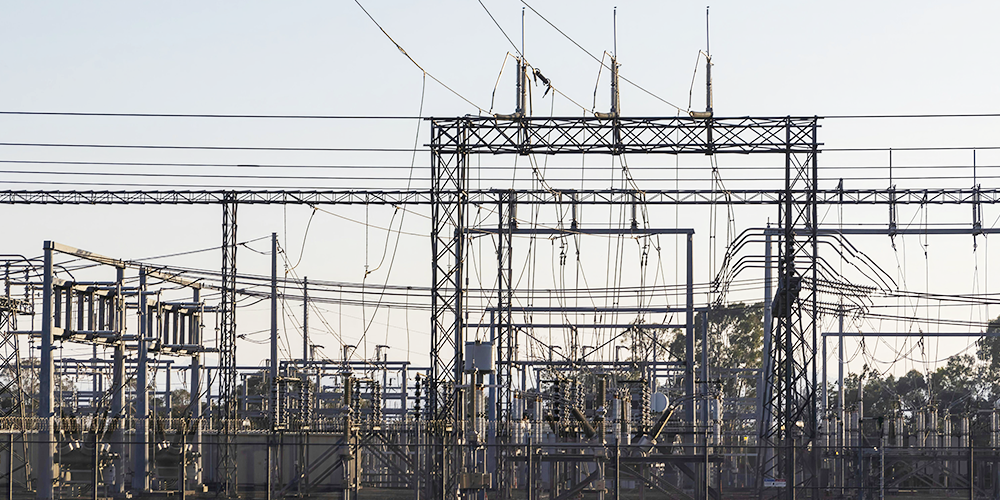
Pooling Substations: The Backbone of Large-Scale Renewable Energy Projects
With wind and solar projects ballooning in size as renewable-energy capacity rushes around the world, they continue to be built at a larger scale. Wind and solar farms today are typically composed of dozens, even hundreds of individual generating units that span over hundreds of square miles. Although power generation technologies have made large progress, efficient and reliable power evacuation is now one of the most serious bottlenecks to large scale renewable energy deployment.
It is not economically and technically feasible to connect every power generation unit directly to the grid. This is where pooling stations come into play. Pooling substations serve as centralised power collection and evacuation points, which support larger projects to connect in an optimal way with the transmission grid by providing reliability, efficiency, interconnectivity and compliance with certain grid codes.
What Is a Pooling Substation?
Pooling Substation (PSS): Centralized electrical sub-station to gather energy from multiple wind turbines or solar inverter blocks, concentrate at medium-voltage level and step-up to higher voltage for further evacuation into the transmission network.
In most renewable projects, power is generated at low or medium voltages of individual turbines or solar blocks (frequently 690 V, 33 kV up to 66 kV). This power is collected into a pooling substation and exported at either 132 kV, 220 kV or sometimes 400 kV depending on the requirement of the grid as well as scale of project.
The pooling is nothing but ‘Combining’ of powers from more than one generating station to connect through a single evacuation point connected to the grid, so as not have too many points for connection and simplifying infrastructure overall.
Key Functions of a Pooling Substation
Pooling substations perform several critical functions within renewable energy projects:
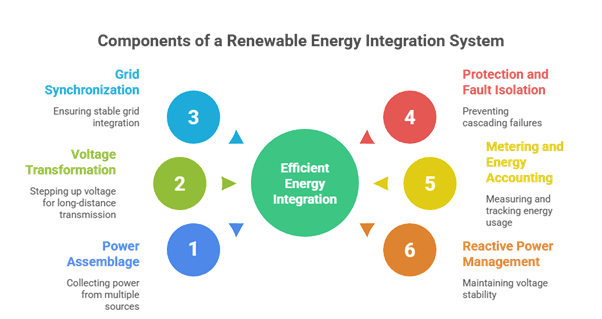
- Power Assemblage: Collection of electrical power from different wind turbines and from multiple solar blocks through MV feeders and accumulate it at a central location.
- Voltage Transformation: Combing substations step up voltage from medium voltage (33/66 kV) to high voltage (132/220/400kV), enabling efficient long-distance transmission with reduced losses
- Grid Synchronization and Control: They ensure synchronization with grid parameters such as voltage, frequency, and phase angle, enabling safe and stable grid integration.
- Protection and Fault Isolation: Advanced protection schemes isolate faults quickly, preventing cascading failures and minimizing downtime across the project.
- Metering and Energy Accounting: To the point and perfect metering systems support energy measurement, regulatory compliance, and billing.
- Reactive Power Management: Maintaining voltage stability and complying with grid code requirements by reactive power compensation systems.
Important Components of Pooling Substation
A proper pooling stations and substation contains following major elements:
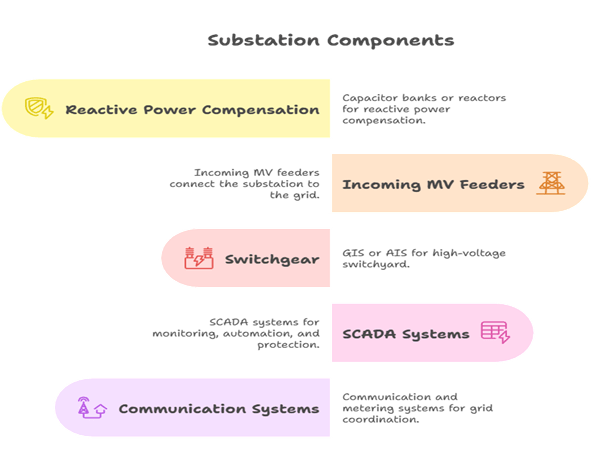
- Reactive power compensation equipment such as capacitor banks or reactors
- Incoming Medium voltage feeders
- GIS (Gas insulated switchgear) or AIS (Air insulated switchgear) for high-voltage switchyard.
- SCADA systems for monitoring, automation, and protection, control
- Communication and metering systems for grid coordination and data acquisition
Every component has been carefully engineered to ensure safety, reliability, and long-term operational performance.
Pooling Substation vs Unit Substation (USS) / DP Yard
| Aspect | Pooling Substation | Unit Substations (USS) /DP Yard |
| Primary Role | Central Power aggregation | Local collection |
| Voltage Level | Medium Voltage to High Voltage (132 kV+) | Low Voltage/Medium Voltage |
| Grid Interface | Direct grid connection | Feeds pooling substation |
| Project scale | Large renewable parks | Medium clusters / Local networks |
| Site | Centralized | Distributed |
Pooling substations serve as the final evacuation interface between renewable projects and the transmission grid.
Design Consideration for pooling substations
Substation works is much more important than electrical design planning. Key considerations include:
- Flood risk, behaviour of drainage, terrain profile
- Constructability, access, and land availability.
- Maintainability (RAM) targets, availability, reliability.
- Redundancy requirements and Grid code compliance.
- Protection co-ordination and Short-circuit levels.
- Installed capacity and future expansion provisions.
Execution challenges and design errors are easily avoidable through early-stage planning and multidisciplinary engineering.
Construction and Execution Challenges:
Building pooling substations is a complex and multidisciplinary undertaking. These facilities serve as critical infrastructure nodes that consolidate power from multiple generating stations before evacuation to the grid. Their scale, technical requirements, and regulatory dependencies make execution particularly challenging. One of the primary hurdles is land acquisition and right-of-way clearances, which can significantly impact project timelines. In parallel, the procurement of long-lead items such as power transformers and high-voltage switchgear often introduces scheduling risks due to manufacturing and delivery timelines.
Coordination with transmission utilities and grid operators is another crucial aspect. Synchronizing construction progress, protection schemes, and grid readiness requires precise planning and structured communication among stakeholders.
Stringent safety regulations and quality control standards further elevate the complexity. From civil works and equipment installation to testing, commissioning, and grid synchronization, each phase must meet regulatory and operational benchmarks.
Successful delivery depends heavily on disciplined project management and technical coordination. Without structured oversight, risk mitigation, and integrated scheduling, delays and operational challenges can quickly escalate. Pooling substations are not merely electrical installations. They are strategic grid infrastructure assets that demand engineering precision and execution excellence.
Importance of Pooling Substations in Modern Renewable projects
Pooing substations are no longer optional components- they are strategic enablers for large-scale renewable deployment. Their importance lies in:
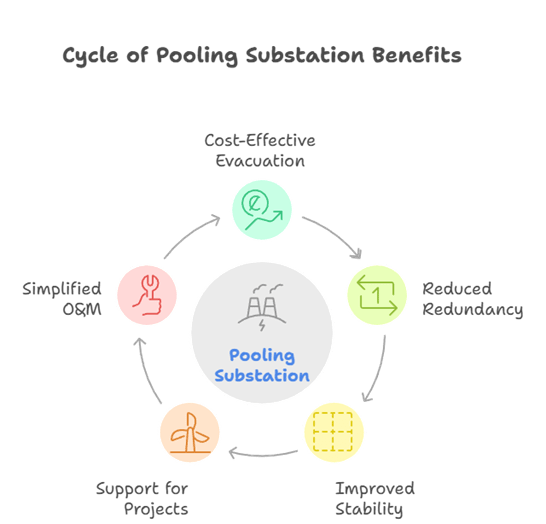
- Enabling cost-effective power evacuation
- Reducing transmission infrastructure redundancy
- Improving grid stability and controllability
- Supporting utility-scale wind, solar, and hybrid projects.
- Making operation & maintenance simplified.
As the renewable energy works increases, well-designed pooling substations will continue to play a central role in grid resilience. x
How NeXHS Delivers optimized pooling substation solutions?
While pooling substations play a critical role in power evacuation, their long-term performance depends heavily on-site selection, terrain suitability, hydrological behaviour, and constructability. Inadequate assessment of these factors can lead to flooding risks, excessive earthwork costs, and operational challenges.
At NeXHS Renewables, our pooling substations are developed as a site-sensitive engineering problem, not just an electrical design. NeXHS’s pooling substation optimization incorporates advanced hydrological modelling, terrain assessment, and earthwork optimization to help make informed decision-making from the earliest project stages.
This approach enables project teams to:
- Accurately assess flood risks using 100-year inundation projections
- Analyse seasonal groundwater variation and watershed behaviour
- Develop terrain-optimized layouts using digital elevation models (DEM)
- Reduce construction costs through precise earthwork volume optimization
- Support smarter site selection and long-term operational resilience
To deliver comprehensive, location-specific insights, NeXHS deploys industry-leading tools such as HEC-RAS, HEC-HMS, MODFLOW, ArcGIS, and AutoCAD. These allow for integrated evaluation of hydrology, terrain behaviour, and constructability well before construction begins.
This methodology has already been applied successfully on pooling substation sites spanning approx. 99,000 sq.m including locations with dynamic elevation profiles and sloping terrain-helping projects minimize execution risk while optimizing capital expenditure.
Enabling Reliable and Resilient Renewable Power Evacuation
Since the rise of wind and solar projects continue to scale up, these pooling substations have become indispensable infrastructure for reliable and grid-compliant power evacuation. Beyond electrical design, modern pooling substations demand a multidisciplinary approach that accounts for terrain behaviour, flood risk, groundwater conditions, and long-term site resilience.
By combining advanced hydrological modelling, geospatial analysis, and earthwork optimization, NeXHS supports developers and EPCs in designing pooling substations that are technically robust, cost-efficient and future-ready-enabling renewable projects to perform reliably throughout their operational life.