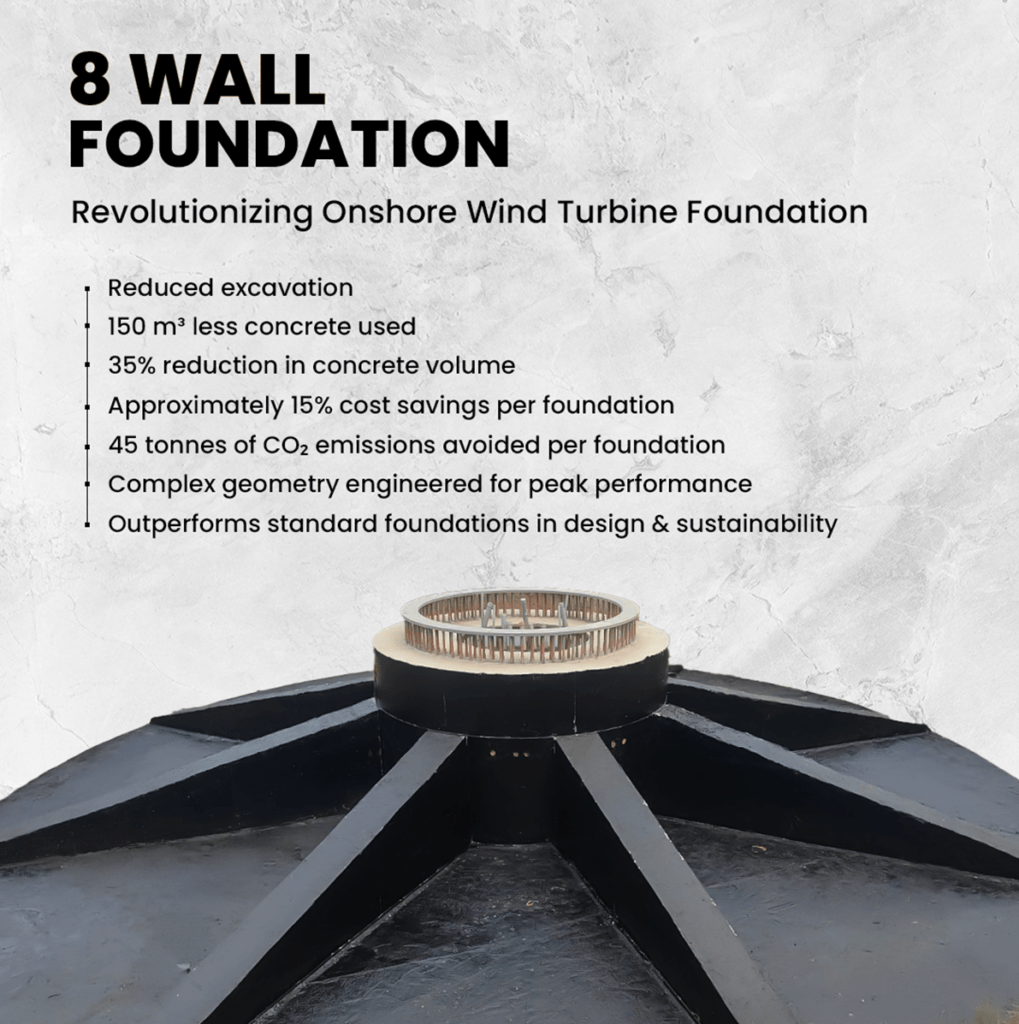


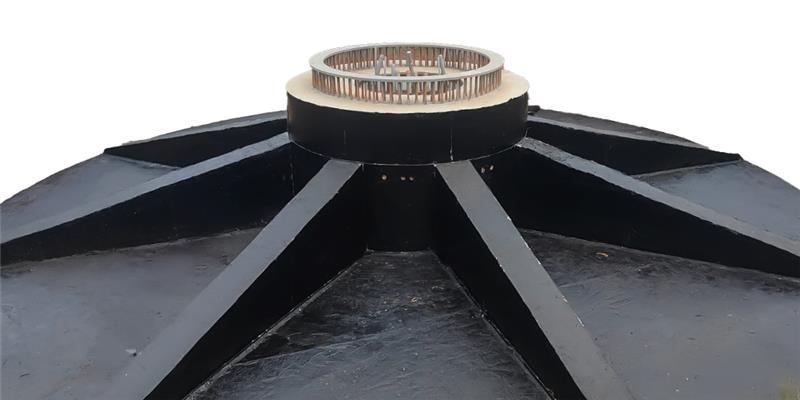
8-Wall Foundations: A Smarter Foundation System for Modern Wind Turbines
With wind turbines growing significantly larger and taller, foundation design has become one of the most critical engineering challenges in modern wind energy projects. Today’s turbines feature higher hub heights, longer blades, and increased rated capacities, all of which generate substantially higher vertical loads, overturning moments, and cyclic fatigue forces at the foundation level.
Traditional gravity foundations-designed primarily to resist loads through their sheer mass are increasingly proving inadequate for these modern demands, as turbine sizes scale up, gravity foundations require enormous concrete volumes, deeper excavations, and higher costs, while still facing limitations in crack control and long-term fatigue performance.
To address these challenges, the wind industry is rapidly adapting more structurally efficient foundation concepts, one of the most advanced being the 8-wall foundation system. Designed to handle heavy loads through engineered load paths rather than mass alone, the 8-wall foundation offers superior performance, optimized material usage, and improved durability-making it a preferred choice for next-generation wind projects.
What is 8-Wall Foundation?
An 8-wall foundation is a reinforced concrete wind turbine foundation system consisting of eight vertical structural walls arranged in a radial or configuration around the turbine tower base.
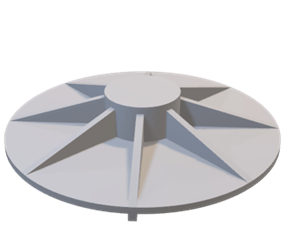
Unlike conventional gravity foundations that rely mainly on dead weight to resist overturning, the 8-wall foundation transfers turbine loads into the ground through structural wall action. These walls act as stiff load-resisting elements that efficiently channel vertical loads, horizontal forces, and overturning moments into the surrounding soil.
By mobilizing defined and predictable load paths, the 8-wall system:
- Improves global stiffness
- Reduces stress concentrations
- Enhances fatigue performance
- Delivers superior long-term structural behaviour
This approach makes it particularly suitable for tall towers, large rotor diameters, and sites with challenging soil conditions.
Key Components of an 8-Wall Foundation
An 8-wall foundation typically consists of the following elements:
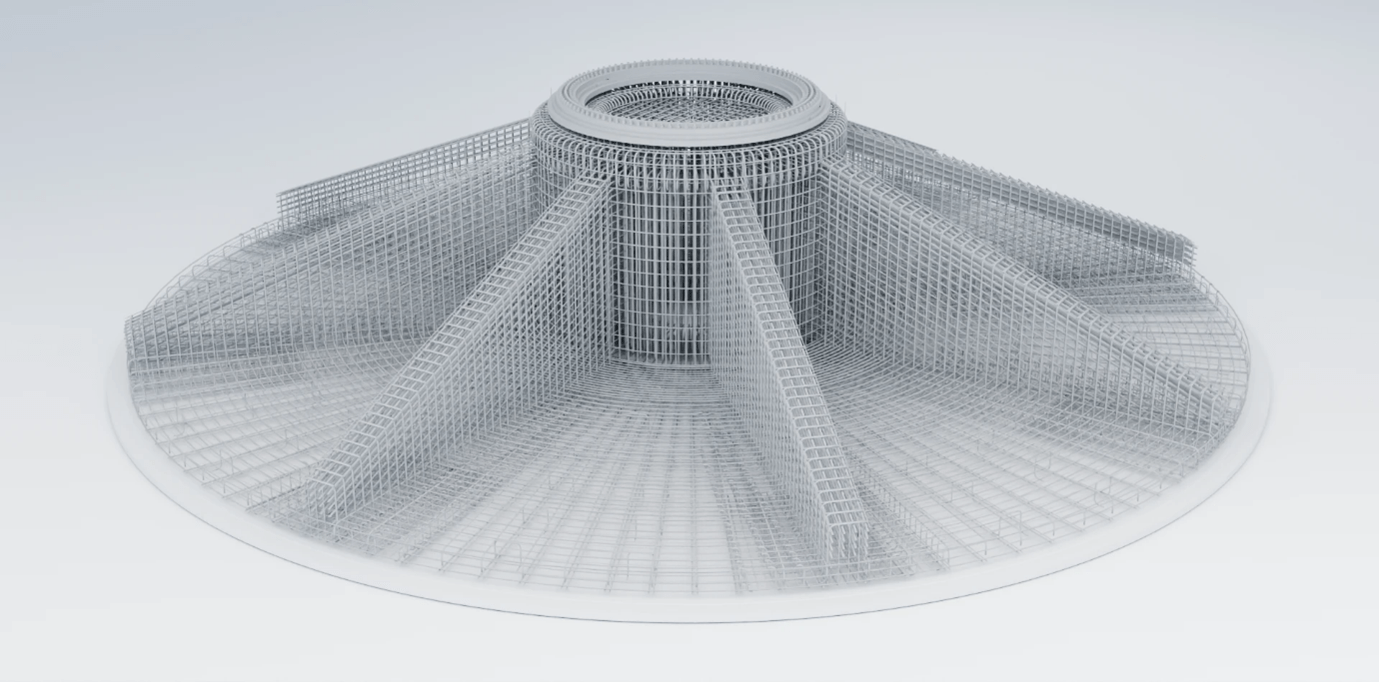
- Foundation Slab or Raft: The base slab distributes vertical loads uniformly to the ground and serves as the primary interface between the foundation and the soil. It also integrates the wall system into a single monolithic structural unit.
- Eight Reinforced Concrete Walls: The defining feature of the system, these walls are arranged at 45-degree intervals around the central pedestal. They resist overturning, shear forces, and cyclic loading by acting as vertical cantilever elements embedded in the soil
- Central Pedestal and Anchor Cage: The pedestal connects the wind turbine tower to the foundation through a precisely aligned anchor cage. It transfers turbine loads directly into the structural wall system and ensures accurate tower installation.
- Backfill and Compaction Zone: Properly compacted backfill around and between the walls provide lateral confinement, enhances soil-structure interaction, and contributes significantly to overall stability and stiffness.
Together, these components create a robust load-resisting system capable of handling high structural and dynamic demands
Why 8-Wall Foundations Are Used in Wind Projects
1. Efficient Load Transfer
The eight-walls configuration enables uniform transfer to vertical loads, overturning moments, and cyclic wind induces forces into the soil.
By distributing stresses across multiple structural elements, the system minimizes localized overstressing and significantly improves foundation performance under both ultimate and fatigue load cases.
2. High Resistance to Overturning
Tall wind turbines generate enormous overturning moments due to wind loading and rotor dynamics. The radial wall geometry of the 8-wall foundation provides exceptional resistance by:
- Increasing lever arms against overturning
- Mobilizing soil resistance more effectively
- Reducing reliance on dead weight
This makes 8-wall foundations ideally suited for high hub heights, large-capacity turbines, and extreme wind conditions.
3. Reduced Concrete Consumption
Compared to massive gravity foundations:
- Concrete volume is significantly optimized
- Structural efficiency is improved
- Excavation quantities are reduced
Lower concrete usage not only reduces construction costs but also lower embodied carbon, making the solution more sustainable and environmentally responsible.
4. Improved Crack Control and Durability
The wall-based structural system offers superior performance under repeated cyclic loading. Key durability benefits include:
- Better crack width control
- Reduced tensile stresses in concrete
- Improved fatigue resistance
These factors enhance long term durability, minimize maintenance risks, and extend the foundation’s service life.
Improved soil-structure Interaction
One of the most important advantages of the 8-wall foundation is its enhanced soil structure interaction (SSI).
Unlike gravity foundations, which passively rest on the soil, the 8-wall system actively engages the surrounding ground through its embedded walls. This interaction:
- Improves lateral stiffness
- Reduces differential settlement
- Enhances load-sharing between soil and structure.
Where Are 8-Wall Foundations Typically Used?
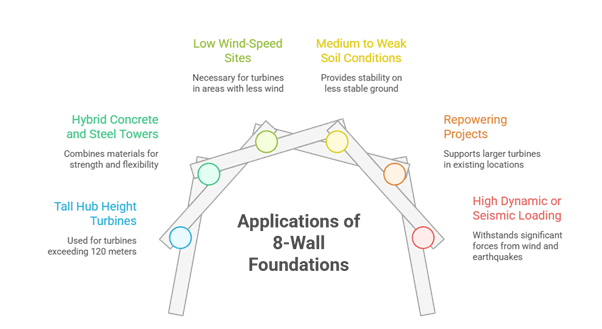
8-Wall Foundation vs Conventional Gravity Foundation
| Aspect | Gravity Foundation | 8-Wall Foundation |
| Load resistance | Mass-based | Structural wall action |
| Concrete quantity | Very high | Optimized |
| Crack control | Moderate | Superior |
| Suitability for tall towers | Limited | Excellent |
| Material efficiency | Low | High |
| Long-term performance | Standard | Enhanced |
Construction Overview
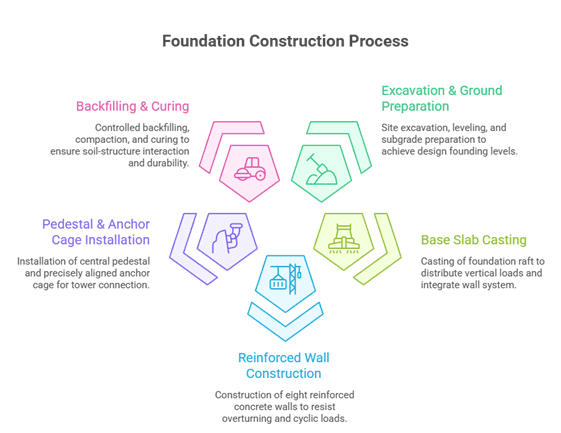
This phased construction approach allows for better quality control, easier reinforcement handling, and improved construction safety.
Sustainability and Environmental Benefits:
With the wind industry placing increasing emphasis on sustainability, the 8-wall foundation offers clear environmental advantages:
- Reduced concrete and cement consumption
- Lower embodied carbon footprint
- Smaller excavation volumes
- Reduced site disturbance
These benefits align strongly with modern ESG goals and sustainable infrastructure development practices
Role of 8-Wall Foundations in Modern Wind Projects
As wind turbines become taller and heavier, foundation systems must evolve accordingly.
8-wall foundation provide:
- Better structural performance
- Lower material usage
- Improved fatigue resistance
- Greater design flexibility
They are a key enabler for next-generation wind turbines, supporting taller towers while maintaining safety, durability, and cost efficiency.
8-wall foundation: Enabling Taller and Smarter Wind Turbines Through Efficient Foundation Design
As wind turbines continue to increase in size and structural demands, foundation systems must evolve beyond traditional gravity-based solutions. The 8-wall foundation offers a structurally efficient, durable, and sustainable approach for supporting modern, high-capacity wind turbines.
For project stakeholders seeking deeper insight into 8-wall foundation details and 8-wall foundation cost, NeXHS provides comprehensive engineering expertise, design support, and practical guidance to help evaluate and implement this advanced foundation system effectively.